Showing posts with label side dishes. Show all posts

Monday, May 25, 2015

a new season


What is this blog now? That's a really good question.

While looking around here a couple of days ago, I realized that I need to go in and change my profile section because it's no longer current – though, of course, it is part of my past. I no longer have a fiancé. It's been seven years since I lived in New York. I've changed teaching jobs twice since I first drafted that "about me" paragraph. All of which is to say, it will be updated soon to reflect where I am now – or at least the thumbnail sketch version of it.

But condensing where I am to a single paragraph is more difficult than it might sound. When I first began posting, the accidental kitchen represented something similar to what running and crafting and thrifting and photography were in my life: it was an activity that gave me confidence, that allowed me to play and experiment and create. I still want to do all those things, but their significance for me has changed dramatically in the last year or so. 

I'd like to explore that change here, and that means the way I do posts might change, too. So, some might end up being shorter. I imagine I'll still have a long, circuitous, generously hyperlinked meditation every now and again. However, I can tell you that for months now, at least two or three times a week, I've been making some delicious food and drink, and I want to share these inventions and experiments, more frequently and in a briefer format. Never fear: there will still be odd stories and rabbit trails and digressions – it's me, after all. 

I'm happy to have anyone along who's game for the ride. 


So: what better time to begin this new chapter than now, I figure. 

As of tomorrow, I will have been finished with grading for exactly two weeks, and unlike the beginning of every other summer break in my recent memory, this one found me immediately relaxed and chilled out and ready to cook and read and play.

Last night N and I fired up the grill for the first time this season. We needed a couple of grill-friendly recipes, and between us, we came up with a really delicious combination of dishes.

I went looking through the folder full of recipes on my computer and found this one, an old recipe that I first encountered on Good Deal with Dave Lieberman, a Food Network show that aired in 2005. I'm not even sure whether it had a second season or not. I made the recipe ten years ago this summer, and as far as I can recall, I really enjoyed it. That first time, however, I made it on a cast-iron grill pan on the stove, and I do remember that it smoked up the kitchen pretty good, so I thought taking it outside to the charcoal grill might be a good idea this go around. I have adapted the recipe a bit by doubling the marinade, which makes for a lot more creamy goodness to serve over the rice and the shrimp. I also added some fish sauce at the end, which deepens the funkiness a little. You can omit it if you really don't like fish sauce, though I have to tell you, a little dash of it is very subtle and yummy in the sauce.

N suggested we make some Pod Oeng (Coconut-Grilled Corn), which he had made before, but I'd never tried, and all I can say is lawzy. It gave me yet another reason – as if I needed any more reason than this recipe or this one – to adore corn's sweet summer goodness. Bonus: between the shrimp, the rice, and the corn, you'll use up a single can of coconut milk. 

We also had a big bowl of leftover Roasted Beet and Feta Salad with Orange Vinaigrette (the recipe for which I'll be posting soon), and that added some nice color to the meal.

Hope y'all are enjoying these warm evenings as much as I am.

Cheers,
H.


grilled spicy coconut shrimp with coconut jasmine rice
recipe adapted from an episode of Good Deal with Dave Lieberman (Food Network, 2005). It's also apparently in his book, Dave’s Dinners: A Fresh Approach to Home-Cooked Meals, if you can get your hands on a used copy.
  • 2 good-sized fresh jalapeños, sliced (I left the seeds in for extra heat)
  • 5 or 6 small garlic cloves, thinly sliced
  • 2-inch piece fresh ginger, peeled and grated
  • 4 tablespoons dark brown sugar
  • 4 tablespoons soy sauce
  • zest of one lime
  • 1 can unsweetened coconut milk
  • large handful basil leaves, torn
  • 2 tablespoons vegetable oil
  • generous ½ teaspoon salt
  • 20 grinds fresh black pepper
  • 1 pound peeled, deveined shrimp
  • 10 or so wooden skewers, soaked in water for at least 30 minutes
  • 1 to 2 tbsp. fish sauce
  • 1 cup jasmine rice
  • 1¼ cups reduced-sodium chicken broth

In a mixing bowl, combine the jalapeños, garlic, ginger, brown sugar, soy sauce, lime zest, ½ cup of coconut milk, basil, vegetable oil, salt, and pepper. Add the shrimp and marinate at room temperature for at least 30 minutes and up to 4 hours refrigerated.
String 4 to 5 shrimp onto each wooden skewer (make sure they’ve been soaked in water for at least a half hour), and put them on a large plate. You can thread on some of the jalapeño rings, as well, if you like.

Add chicken broth, ¼ cup of the coconut milk, a sprinkling of salt to a medium saucepan. Taste mixture for saltiness. Stir in rice. Bring to a boil, then cover tightly and lower heat. Simmer, tightly covered, for 15 to 20 minutes. Turn off heat and let rice sit, still covered, while you prepare everything else.

Add the reserved marinade to a small saucepan. Bring to a boil for a couple of minutes, to cook any of the raw shrimp juices and so it can thicken, then turn off the heat and stir in the fish sauce. Taste and more coconut milk and/or soy sauce and/or salt if desired. Keep warm.

Prepare charcoal briquettes. Let them get very hot, and then spread them in the bottom of your grill. (Or, if you’re doing this on a stove, heat a grill pan over high heat until smoking hot, about 5 minutes.) Put your grill on, let it burn off some of the crud, and then scour it well with a crumpled piece of aluminum foil. Brush some oil on it.

Grill the skewers until the shrimp are well browned on each side, turning once, about 3 to 4 minutes total. Transfer the cooked shrimp to a clean serving plate. 

Fluff rice.
Pour the reduced marinade into a small serving bowl and serve alongside the grilled shrimp and rice.


Monday, April 28, 2014

wilted salad


Hear me out. In this case, the phrase “wilted salad” is a recipe title, not a criticism. You actually wilt this salad on purpose. Full disclosure: it doesn’t turn out pretty. But it does turn out yummy.

This is my paternal grandmother’s recipe, and she taught it to my mother, who made it often when I was younger, so this tastes like childhood to me. But even if I were trying it first as an adult, without the added attraction of nostalgia, I think I would still enjoy it because it’s vinegary, salty, and bacony, three of my favorite flavor profiles.

So, without further ado, here it is. Super easy.

wilted salad
3 slices of bacon
a head of iceberg lettuce
a bunch of scallions
1 tsp. sugar
2 tbsp. apple cider vinegar (or to taste)

Fry bacon slices until crisp. 

While bacon is frying, remove core from lettuce and tear the rest of the head into pieces, separating the leaves as you go. Chop scallions, including the green tops.

Remove bacon from skillet and drain on a paper towel.

Dip out some of the bacon drippings until you have a couple of tablespoons left in the skillet. Add sugar and vinegar to the drippings and stir until sugar is dissolved. Add lettuce and scallions to the hot pan, turning them so that they get some of the dressing. Add a good pinch of salt and some pepper. Continue turning the greens until they are barely wilted. Crumble bacon and add to the pan. Taste and adjust seasonings, if needed.

I’ve never added hot sauce to this, but I bet it’d be fabulous.


Wednesday, July 31, 2013

an unreliable narrator


Trust the tale, not the teller.     
                   - D. H. Lawrence


There's something you should know about me: I am miserable at bullshit. Both giving and receiving. Mine is no kind of poker face. And I'll believe anything.

One day when I was in college, my mother gave me a ride to campus. We were listening to a CD of the Impressions' greatest hits, and I spontaneously exclaimed, "Their music is so uplifting! It always makes me feel inspired." Mom looked serious and said soberly, "In reality, some very depressed people. Alcoholics."

My face fell. "Really?"

"No," she said with a smirk, as she glanced at me sideways.

Because that is how this little song-and-dance goes. Deceiving me is easy and also, apparently, funny as hell. Just ask my friends and family. At one point during a trip to D.C., my mother told me that our country's first president was buried under the Washington Monument, and when I cried afterwards in embarrassment, she felt bad because she never meant to be cruel. The fibs are always pointless, harmless things she doesn't really think I'll believe, anyway, and she doesn't let me sit in ignorance for more than a couple of seconds before revealing the trick. I think part of the fun is hearing me bellow, "Damn it!" as I do most of the time when I find out I've been had.

Thursday, May 30, 2013

red cabbage salad


So! I'm working on several different posts. Who knows which one will be finished first, or when. In the meantime, I offer a little something to whet your appetite, plus a summer-reading recommendation.

When it gets hot outside, all I want are crunchy, leafy, generally vegetal things. Corn. Tomatoes. Basil. Chives. Lettuce. Zucchini. Half the time, D calls me a rabbit because of my inordinate love for a vegetable plate. (Other times he calls me a hobo because of my inordinate love for sardines.) The truth is, I suspect I would be right at home, crunching on illicit produce all day long in Mr. McGregor's garden.

Monday, April 1, 2013

to do it justice


For as long as I can remember, I've felt an obligation to testify, in the most basic sense of the word: to make a statement based on personal knowledge or belief : to bear witness. When I was a little girl, I wrote poems about the things that happened in my small world—seasons, teachers I admired, friends and relatives who died, holidays. As a second grader, I composed a letter to my Aunt Sherry telling her about how my friend had gone to the doctor and found out her breast was growing. "And I found out I had the same thing!" I explained, as if the breast bud were a tumor or an infection. This was no coincidence; for weeks I'd noticed that I could no longer lean my chest against the dash of my mom's van without wincing, which I saw as a sure sign that something malignant was growing inside my body. Then, as now, I always assumed that it was only a matter of time before I contracted the terminal disease that was coming to me. When I got my first period, even as an eleven-year-old, my first thought ran like this: Of course. Cancer. Even though the secret ate me up, it still took a full 36 hours before I could tell my mom. I don't know why. I think I believed I was really dying this time, and I felt ashamed, because I knew I must have done something terrible to deserve it.

Friday, December 7, 2012

six hundred dollars' worth


Poems I keep thinking about lately: Kay Ryan's "That Will to Divest" and Elizabeth Bishop's "One Art." That section in Robert Hass's "Regalia for a Black Hat Dancer" where he talks about his divorce from his first wife, how during the whole process he imagined the moment when he would finally, deliberately, and ceremonially declare it finished. He visits a Buddhist shrine in Korea and considers leaving his wedding ring there but then decides not to.
In the months we were apart, I had endless fantasies
about when I'd finally take it off and how. And then one day,
I was moving, lugging cardboard boxes, I looked down
and it wasn't there. I looked in the grass of the driveway strip.
Sowbugs, an earwig. So strange.
............................................................
I was searching in the rosebed of a rented house
inch by inch, looking under the carseat where the paper clips
and Roosevelt dimes and unresolved scum-shapes of once
vegetal stuff accumulate in abject little villages
where matter hides while it transforms itself. Nothing there.
I never found it.

He ends with a statement of baffled resignation: "Apparently I was supposed to wait / until it disappeared." In her poem, Bishop is similarly breezy, but of course she's whistling through the graveyard as she names things she's lost, from little to big: "And look! my last, or / next-to-last, of three loved houses went."

Well, Elizabeth, by summer, I too will have lost three loved houses.

Thursday, May 17, 2012

maïs, je t'aime


Which translates: "Corn, I love you." When I typed it, though, I realized that if you omitted the umlaut over the "i" in the initial word (hence altering its pronunciation slightly), you would have this sentence instead: "But, I love you." Ah, the knotty and fascinating problems of translation.

I've always studied French as my foreign language. This, I think, is a perfect example of the wide impractical streak that, à la Pepé Le Pew, runs the entire length of an otherwise fairly down-to-earth person. (Maybe it's my Pisces moon?) If I had really set out to navigate the actual linguistic terrain of the modern United States, I should have studied Chinese, and certainly way more Spanish than the bare-minimum, single semester of "Reading for Spanish Knowledge" required by my doctoral program. (We had to have "familiarity" with two foreign languages—i.e. just enough to be able to grasp the gist of an academic article or, more likely, just enough to get us into trouble abroad.)

Sunday, May 13, 2012

a bouquet of cauliflowers for mother bear


It's Mother's Day. Today I'm reminded of Billy Collins's poem "The Lanyard." Go on, click play and listen. I'll wait right here for you:


I had the pleasure of hearing him read this live a couple of years ago, and I was struck both by how funny and how heartbreaking the poem was. Collins calls it an "archaic truth: that we can never repay our mothers." All right, it may be archaic - but it's still the truth. 

I mention my mom so often that when she said, "Well, are you writing a post about me for Mother's Day?" I sputtered, "Mo-om! I have to work hard not to quote you every other sentence." 

But she's right, as usual. There are still some things to say.

Wednesday, April 18, 2012

haiku + quick pickles


Early in Salman Rushdie's novel Midnight's Children, the main character Saleem Sinai explains that as he feels himself getting older, his desire to tell his own story grows more and more urgent. Identifying himself as a man who has "dedicated [his] latter days to the large-scale preparation of condiments," he declares:

            Rising from my pages comes the unmistakable whiff of chutney...
            And my chutneys and kasaundies are, after all, connected to my
            nocturnal scribblings--by day amongst the pickle-vats, by night
            within these sheets, I spend my time at the great work of
            preserving. Memory, as well as fruit, is being saved from the
            corruption of the clocks.

Warming to his theme, Saleem lectures Padma, his long-suffering wife-to-be: "Things--even people--have a way of leaking into each other... like flavours when you cook... the past has dripped into me... so we can't ignore it..."

I always liked this metaphor. Rushdie uses it to suggest that we are all like pickles, each of us a separate piece of vegetal matter that can be distinguished from another piece. If we are born into the same family or country (or, in the case of the novel, if we are born during the same midnight hour of that country's day of independence), we might find ourselves pickled in a common brine. Over time our shared history, the liquid that surrounds and preserves us, may begin to give us all a similar flavor and color. Nevertheless, each of us is still our own completely distinct, separate chunk of cucumber, beetroot, or watermelon rind.

This also resonates with me because I have a refrigerator door literally crammed full of every kind of condiment and relish you can imagine.

Sunday, December 26, 2010

happy (belated) thanksgiving!

the spread
I love Thanksgiving. To be frank, ever since my sister died on the day after Christmas fourteen years ago, my family has always, to some extent, tended to limp a little through the holidays. You have to admit that even without those memories, Christmas is already a bit loaded: if you look forward solely to the presents, the holiday always tends to be anticlimactic. If you focus on being with your family, things turn out much better, but you still can't really avoid the profound case of the blues that sets in the day after. These days, I'm practicing being in the moment more, something that my brother Jeff has always been good at; that tends to pan out more happily than borrowing trouble, which I'm excellent at doing. :)  Anyway, Thanksgiving is so different from Christmas. It's about the food, sure, but it's also a time when all you have to do is hang out with your family and friends, eat, and feel grateful. I can get behind a holiday like that.


This was the first year I ever cooked for more than just D and me. We invited my parents, Jeff, D's parents, and his Grandma down for Thanksgiving dinner so that they could all see the new house, some of them for the first time.


The first Thanksgiving meal I ever cooked was three years ago when we lived in NYC, and I made a whole feast for just D and me in our tiny studio apartment kitchen, which was so small that I had to open the refrigerator door in order to get the oven door open. We were both terribly homesick, knowing that we wouldn't be able to go home until Christmas. D's parents were kind enough to transfer some funds over to his account so that we could go out to eat for our Thanksgiving. We got dressed up and went to Orsay, a French restaurant on the Upper East Side that had a prix fixe menu. The plates that arrived at the table had beautiful, harvest-colored daubs of turkey and vegetable on them in various combinations - very French and fancy. While we were walking home, we stopped in a little newsstand and petted a skinny, elegant black cat with a heart-shaped charm on her collar that, appropriately, had "Paris" engraved on it.


Still, it didn't seem quite right not to have some of the specific dishes we associated with our families - sage-heavy cornbread dressing, standard roast turkey, broccoli casserole, pumpkin pie, et cetera - so I made a meal for us, too. And I wheeled our 13-pound turkey home to our apartment, a dozen blocks down Fifth Avenue, in my "bag lady" cart.


That was a great Thanksgiving, if a bit lonely. This one was bittersweet in its own way: we've lost some important people this year, but I'm so happy that we got to spend Thanksgiving with our families.


just look at that pretty bird!
As for food, this year we decided to do Alton Brown's recipe for turkey because I'd been seeing commercials for it all month. Apparently, it's the most popular Thanksgiving recipe on the Food Network website, and when I looked it up, it had over 2500 reviews and ratings. That's a crazy number of people all making the same kind of turkey.

So, it's wonderful. If you have the time, energy, a few obscure ingredients like candied ginger and allspice berries (plus the extra refrigerator space for a brine-and-turkey-laden 10-gallon bucket), it is so worth it to make this turkey. The guy has figured out how to cook an entire bird so that it hits its various recommended internal temperatures simultaneously and thus stays moist, not to mention making sure the skin gets beautifully fried and golden brown. 

Anyway, here is the rest of the menu from Thanksgiving:


      Paula Deen's Mushroom Canapes (also delightful with some artichoke hearts thrown in)
      Alton Brown's Roast Turkey and gravy
      Claire Robinson's Add Thyme for Whipped Potatoes
      classic Campbell's Soup green bean casserole
      my Nana's broccoli casserole
      Sîan Griffiths's sweet potato soufflé
      my great-grandmother's cornbread dressing
      D's Granddad's cornbread dressing
      roasted brussels sprouts with bacon and balsamic reduction
      D's mom's pecan pie
      apple stack cake
      pecan pie


Happy holidays, y'all.


Cheers,
H.

Monday, October 4, 2010

lady peas in country ham and thyme broth


Yes, sir - it's officially fall. Happily, despite the cooler weather, there are still field peas to be eaten. I had never made lady peas or, truthfully, even heard of them until I came to live in Alabama. I've seen them often enough on local menus, and Frank Stitt spends at least a page in his gorgeous cookbook, Frank Stitt's Southern Table, explaining the delicious nuances that distinguish various kinds of beans and peas, including a mention of this particular legume. 


Anyway, there's a vegetable stand on Rocky Ridge, and after my run on Friday I stopped by to see what they had. I left with a bag of okra, a ziplock of homemade boiled peanuts, and a couple of pounds of already shelled lady peas. I saw them and thought, hey, they have to be something like black-eyed peas, right? Which are awesome, by the way. 


Now for the second part of this recipe idea. Last fall, D and I went to see U2 play in Atlanta, and we ended up making a short vacation of it and spending two nights at The Mansion on Peachtree, which is entirely lovely - probably because it's also an apartment building in addition to being a hotel. P.S.: any hotel where you can order middle-of-the-night hot fudge sundaes and freshly baked chocolate chip cookies from room service is all right by me. 


We had read that Craft, one of Tom Colicchio's restaurants, was next door to our hotel, and as longtime Top Chef fans, we really wanted to try it. (I have loved Tom Colicchio ever since, in an earlier season of the show, he roundly lectured a contestant who had made some terrible fish concoction, and his most pointed criticism was that she had not shown sufficient respect for the creature who gave its life to make that dish. That profound gratitude and reverence for ingredients, particularly animal-derived ones, is one reason why I am also a huge fan of Eric Ripert.) We didn't arrive early enough on the first night for dinner at Craft, which ended up being fortuitous, because the lunch we enjoyed instead the next day was one of the best meals of my life so far. I had perfectly pan-roasted trout with gnocchi that were like pillows of mashed potato souffle, served over a succotash of fresh corn and beans, and swimming in a shallow bowl of (miraculously!) perfectly seasoned country ham vinaigrette. D's lunch was no less amazing: short rib cannelloni baked in béchamel sauce, possibly the richest thing I'd ever tasted. 


Yesterday I looked at my huge pile of fresh lady peas, and I thought: these want country ham. This recipe does take a little time and effort - like everything else I seem to make - but it's worth it. Two bits of advice: firstly, think carefully before adding any additional salt to this recipe. Believe me, I know it's second nature to season as you go, but the country ham broth, while tasty, is very salty already. You may find that you taste the final result and don't need to shake anything on top of it - this recipe was one of the few times that has ever happened to me, and I really like salt. Secondly, when you serve yourself up a bowl of this, make sure that you get plenty of the pot liquor. It is like liquid gooold.


lady peas in country ham and thyme broth


for the broth:
1 tbsp. unsalted butter
1 tbsp. olive oil
3 slices Smithfield country ham, cut into one-inch strips
about 4 cups water
6 to 8 stems of thyme
2 green onions, chopped (including green tops)
1 tsp. whole black peppercorns

for the peas:
1 tbsp. olive oil, divided
1 tbsp. unsalted butter
1/2 white onion, finely chopped
8 to 10 stems of thyme, half of them stripped
3/4 cup dry white wine
country ham broth
2 lbs. shelled fresh lady peas, picked over and rinsed
1 slice Smithfield country ham, roughly chopped


Make the broth: Fry country ham strips in a couple of teaspoons of olive oil, turning once, until they’re browned some on both sides. Add ham and any remaining pan juices and bits to a medium saucepan filled with about four cups of water. Add a pat of butter, thyme stems, green onions, and peppercorns. Bring to a boil and then lower heat and simmer for at least 30 to 45 minutes, until you have about a cup to a cup and a half of liquid remaining.  Strain broth and reserve as much of the ham and green onions as you can. Chop them roughly. Discard thyme stems and peppercorns.

In the same unwashed saucepan over medium heat, melt butter and olive oil. Let butter sizzle a little until it smells slightly nutty, and then add chopped onion. Sauté for 3 to 5 minutes until onions are somewhat caramelized, adding thyme leaves midway through so that they infuse the butter and oil. Pour in white wine and crank up the heat to high. Reduce until there’s about 1/4 cup of liquid remaining.

Pour in country ham broth, chopped country ham and onions from it, lady peas, and 4 to 5 whole thyme stems. Bring to a boil and then reduce heat to a simmer. Skim foam as it rises to the top, and continue until the peas stop foaming. Cover and simmer for 20 minutes or so, just until they’re tender. Remove thyme stems.

While the peas are cooking, heat another teaspoon or two of olive oil in a pan over high. Fry chopped country ham slice until it’s browned and crisp. Drain on a paper towel.

Serve lady peas in a small bowl with a generous scoopful of broth and a sprinkling of crispy country ham on top.

Enjoy!
Cheers,
H.

Friday, September 24, 2010

cocktail and bar snack: gold rush + oven fried okra with smoked tomato aioli


Every summer for the past four years, I've traveled to Louisville, Kentucky, for eight days in order to read and score high school essays from the current year's AP English Literature Exam. There's much more good stuff from Louisville than you'd think: baseball, horsesMuhammad Ali, killer Ethiopian and Persian food, My Morning Jacketcool fossils, and bourbon a-go-go... 


Because this small city's downtown suddenly swells with over a thousand high school and college English teachers during that week in June, it's always a bit of a mixed bag: it is admittedly something of a socially awkward nerd-fest (present company included), but also, and at the same time, it's full of some of the coolest and most interesting people you'll ever hang out with, all of whom are packed into one frigid, fluorescent-lit convention center for a week of eight-hour days spent scoring largely mediocre high school writing, and who are chomping at the bit by five o'clock in the evenings for anything else to do but read. So, to pass the time, we have been known to find good restaurants, go bowling, do silly karaoke, dance at Howl At the Moon (shout-out to my man Ed), and drink lotsa bourbon.


This just in: whiskey
futures are soaring.
One of the more surprising spots in the downtown area is Proof, the bar and restaurant attached to the 21st Century Museum Hotel on Main Street - part hotel and part museum - which is also so much fun to visit for its rotating art exhibits. My AP friends and I generally eschew Proof on the typical go-out-to-dinner night because it's nearly impossible to get a reservation, but we do insist on going there for drinks on the final evening, when most of the other English teachers are already in bed in preparation for their flights the next day.


Proof has a constantly evolving menu of the best-named cocktails I've seen in a while. Two years ago, I felt obligated to try something called the Dirty Presbyterian, which completely lived up to the name (I only hope I could do as well...). This year was no different: we had a couple of rounds of delicious drinks, including the gold rush (which I found so haunting that I actually hunted down a recipe for it), as well as a basket of fries with an intriguing smoked aioli. I had no idea how to replicate that one at home, but I had just watched a Top Chef episode in which a contestant mentioned a smoked-tomato-something-or-other, so here is my homemade version.


It's probably too fancy to call this aioli. This is basically just a spicy, smoky, tomato-n-mayo-based dipping sauce, but it is GOO-OOD, to quote Cousin Eddie in Christmas Vacation


I've posted the recipe for oven fried okra here, which I realize is only in season during the dead middle of the summer in the South. At any other time, the romas for the aioli will still be available at any grocery store, as will baking potatoes for this best home fries EVER recipe. I recommend substituting your dip-ables as needed, season-wise.


gold rush cocktail
3/4 oz. honey, warmed
3/4 oz. freshly squeezed lemon juice
2 oz. bourbon


Pour all three ingredients into a cocktail shaker without ice and stir until well combined. (Stirring before adding ice keeps the honey from getting cold and congealing into taffy consistency, which will mess up the drink.) Now add several cubes of ice, put the lid and cap on the shaker, and shake vigorously. Strain into a highball glass with a lemon twist or a sprig of mint for garnish.


oven fried okra
1 lb. okra, washed, dried & split down the middle lengthwise
1/2 c. corn meal
sea salt, pepper, garlic powder, and cayenne to taste
olive oil spray (or Pam)


smoked tomato aioli
2 to 3 small roma tomatoes
1 medium garlic clove, minced
sea salt, pepper, sugar, olive oil
2 tablespoons Hellman’s low-fat mayo
1/4 tsp. liquid smoke
a pinch of cayenne pepper
a few shakes of chipotle Tabasco sauce (for the spicy smokiness)


Roast tomatoes:  Preheat oven to 450 degrees. Slice roma tomatoes lengthwise into thirds and remove ribs, seeds, and pulp. Drizzle with olive oil and toss them a bit so that they’re covered completely. Arrange them peel side down in a shallow oven-proof skillet and sprinkle with garlic, sea salt, pepper, and a little bit of sugar – making sure that these ingredients are on top of the tomatoes and not on the bottom of the pan itself. Roast for 20 to 30 minutes, until they’re nicely caramelized and brown. Let them cool.

Don’t turn the oven off! Keep it preheated to 450 degrees.

In a paper bag, pour in cornmeal, garlic powder, cayenne, and salt and pepper to taste. Shake it around so that it mixes together. Put in halved okra, twist the top closed, and shake it around so that it’s all coated with the breading mixture. Dump the breaded okra into a not-so-fine sieve over the garbage can and shake all the extra corn meal off of it. Grease the bottom of a large rimmed baking sheet with olive oil and then arrange okra in a single layer, cut side down, spraying the top of everything well with Pam (or drizzling with olive oil). Roast okra for 30 minutes, shaking or turning it halfway through cooking time to make sure both sides get browned and crunchy.

While okra is cooking, in a small food processor combine cooled roasted tomato pieces, mayo, liquid smoke, and a tablespoon or so of olive oil. Blend until smooth. Add a sprinkle of cayenne and or few shakes of chipotle Tabasco sauce to taste (more if you like it spicy) and give a couple of extra pulses of the food processor to incorporate.  

Serve okra with aioli for dipping.

Sit back on your porch and enjoy your Kentucky-endorsed cocktail and bar snack.

Cheers,
H.

Wednesday, September 8, 2010

sautéed corn with garlic, basil, and parmesan


This recipe was inspired by a Saturday trip to the East Lake Farmer's Market last month (following our visit to Ruffner Mountain for "Breakfast with the Animals," where we were the only adults present who didn't have children in tow, and where we got to meet and pet a possum, a screech owl, a box turtle, and a corn snake). We came home excited, tired, and laden with a huge bag of local produce, which I ended up making into a vegetable plate - incidentally, one of my favorite things to have for a summer supper - including sautéed corn, quick pickles, oven fried okra, and black-eyed peas with onion and bacon.


I have made this dish on a half-dozen occasions since, always to rave reviews, and I can't help but feel a little guilty because it was totally serendipitous, simple, and thrown-together. But it ends up being surprisingly elegant and impressive looking. 


A couple of tips: it's fine to let the corn and onions get a bit golden and even a bit golden-brown, but do yourself a favor and don't let the garlic brown. Just clear a little space in the pan, melt a tiny pat of butter there, add the finely minced garlic, stir it a little into the pool of butter, and let it sit and cook for just a half-minute before you work it into the rest of the corn/onion mixture. It will be buttery and garlicky, and between that and the lemon zest and the basil, your kitchen will smell like heaven. Tip number two: be sure you use a very sharp knife when you cut the corn off the cob. Finally, it can be messy work, so if you have a porch, I recommend doing your cutting outside so that you can just let the kernels fly.

sautéed corn with garlic, basil, and parmesan

4 fresh ears of white corn, cut off the cob
2 or 3 tbsp. butter, divided
1 to 2 tbsp. olive oil
half of a white onion, minced (a couple of small shallots will work, too)
1 medium clove garlic, minced
5 or 6 large basil leaves, finely chopped
zest of one lemon
1/4 cup shaved Parmesan
coarse sea salt and freshly ground pepper


Melt olive oil and 2 tbsp. butter over medium to medium-high heat. Add onion and sauté for 2 to 3 minutes until it's softened and light golden.


Add corn and toss in the butter, oil, and onion mixture until it's completely coated. Sauté corn and onion until it’s golden and caramelized, about 5 to 8 minutes.


Make a little space in the pan and melt the remaining 1/2 tbsp. butter, and then add garlic. Sauté just until fragrant, about 30 to 45 seconds.


Remove from heat and stir in the basil and lemon zest, as well as salt and pepper to taste. A minute or two before serving, add the Parmesan and toss just a little bit, so that it doesn’t melt too much and stays in little chunks.


P.S. For my vegan friends, I have a suspicion that this would be perfectly wonderful with just the olive oil and without the cheese. 

My dad says this corn should be illegal.


And a pic of the whole shebang:

I love me some vegetable plate.


Sunday, August 15, 2010

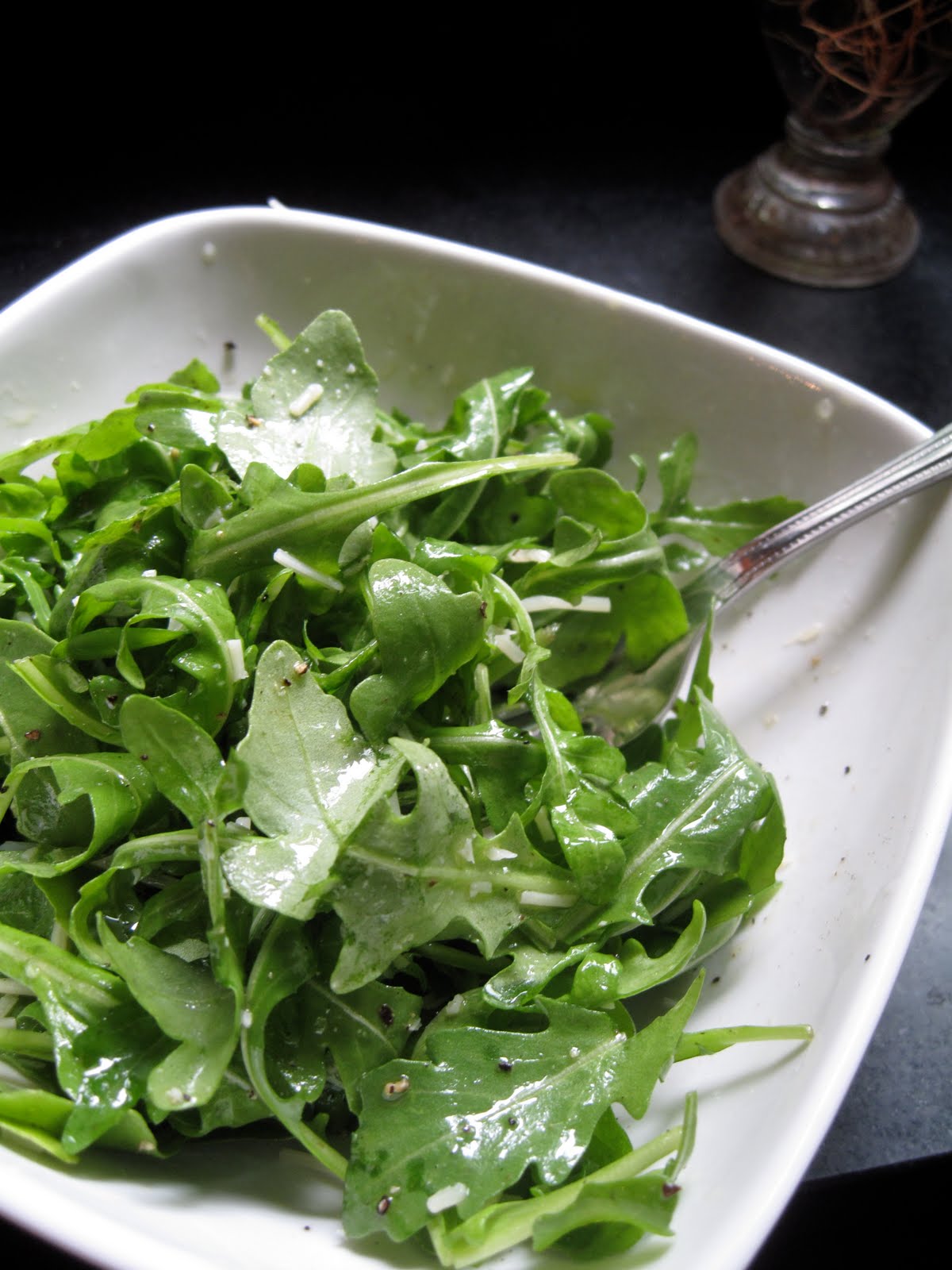
arugula salad

My friends know that the word "arugula" makes me giggle. When you say it, it sounds like the noise that an old-timey car horn makes: ah-rOOOO-gu-la


Anyway, this is one of the easiest salads I've ever made, and I can't seem to stop eating it. It's lovely: crunchy, peppery, salty, and a little bit tart. Even D likes it with his pizza, and he is emphatically anti-salad when it comes to pizza accompaniments. 


Another way we love to eat it is piled on top of a homemade thin crust pizza - we got that idea from an episode of The Best Thing I Ever Ate, where Ted Allen describes his favorite pizza, the arugula and parmesan pie from Graziella's in Brooklyn.


arugula salad
2 to 3 c. arugula leaves, washed & dried
juice of a lemon wedge (or two)
2 to 3 tbsp. extra virgin olive oil
1/2 tsp. coarse kosher sea salt
1/4 tsp. coarsely ground black pepper
2 to 3 tbsp. shredded or shaved Parmesan


Feel free to eyeball all of the ingredients and adjust the amounts for your own taste - you can't really go wrong here. Toss everything together just before serving and pile into salad bowls or on top of pizza. Enjoy!


Cheers,
H.